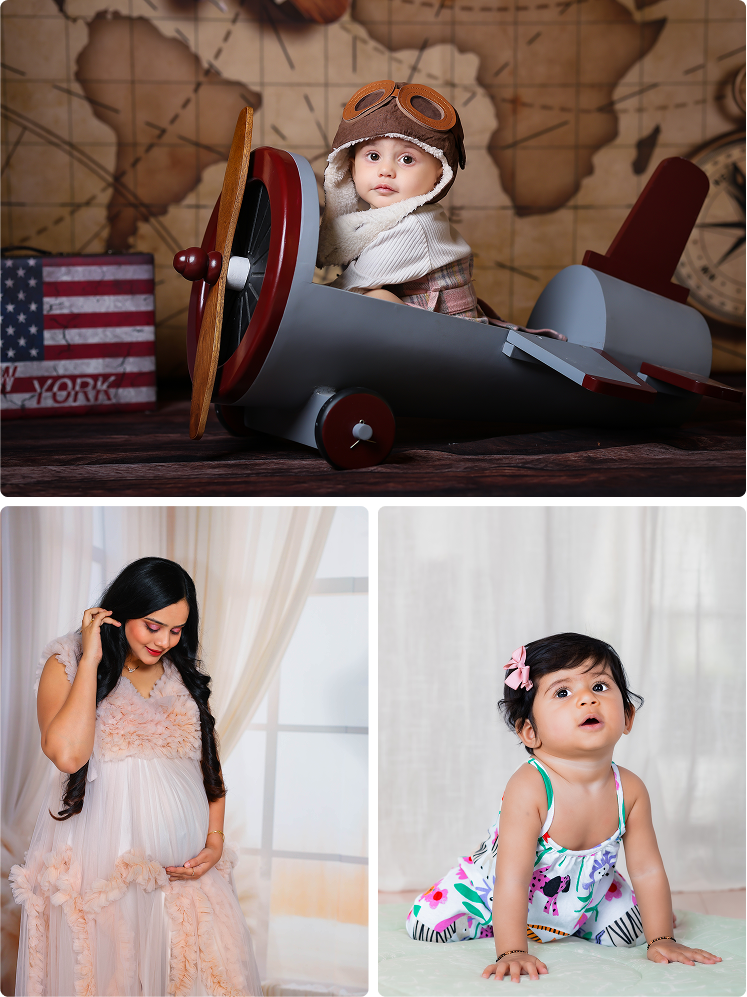
Artificial intelligence is changing how photographs are created and edited. From removing background distractions to generating imaginative scenes, AI tools offer new possibilities for families who want creative baby portraits. At the same time, human photographers continue to bring something important to the process: the ability to observe a baby, respond to their needs, and capture moments as they naturally unfold.
For parents, the question is not simply whether AI or human creativity produces better photographs. It is about understanding what each approach can do, where its limitations lie, and which option best preserves the memories they want to keep.
In baby photography, a polished image can be beautiful, but so can an imperfect photograph of a genuine smile, a curious expression, or a quiet moment between parent and child. The best choice depends on whether your priority is creative experimentation, authentic documentation, convenience, or a combination of these.
What Does AI Bring to Baby Photography?
AI can assist with several stages of photography, including editing, image enhancement, background changes, and the development of visual concepts. Some tools can simplify time-consuming tasks that previously required specialised editing skills.
For example, a parent or photographer might use AI to remove a distracting object, adjust a background, explore colour combinations, or create a visual reference before planning a themed photoshoot.
AI-assisted tools may also help photographers organise images, select potential favourites, and speed up parts of their editing workflow. The exact capabilities depend on the software being used.
However, AI-generated imagery and AI-assisted editing are not the same thing. Editing a photograph captured during a real session is different from generating a portrait that depicts a baby in a scene that never happened.
That distinction matters when families want photographs that document genuine milestones and relationships.
1. Authentic Moments vs Artificially Created Scenes
One of the most meaningful aspects of baby photography is its ability to preserve real moments. A spontaneous smile, a tiny hand gripping a parent’s finger, or an unexpected expression can become a treasured family memory precisely because it happened.
A human photographer can observe these moments as they unfold and capture them without needing to predict exactly when they will occur.
AI can create imaginative scenes, stylised portraits, and visual effects that would be difficult to achieve in a traditional photoshoot. These can be enjoyable creative options, particularly when the family understands that the final image is an artistic interpretation.
The important difference is how the image is intended to be used.
If you want a whimsical portrait of your baby among imaginary stars, AI may be a useful creative tool. If you want to remember your baby’s first birthday, first steps, or interaction with a grandparent, a real photograph preserves evidence of that moment.
Neither purpose is inherently wrong. The choice should reflect what the image means to your family.
2. Human Photographers Understand Context and Emotion
Human creativity involves more than selecting an attractive background or applying an editing style. It also involves understanding the people in front of the camera.
A photographer may notice that a baby smiles when a parent speaks, becomes curious when a familiar toy appears, or needs a quiet moment before continuing. They can adjust the session based on those observations.
They can also listen to parents’ preferences, learn which family traditions matter to them, and suggest ways to include meaningful details without making the setup feel forced.
AI tools can generate suggestions based on instructions, but they do not independently experience the family relationship or observe a live session in the same way a human photographer does.
This is particularly relevant in baby photography, where timing, patience, and gentle interaction often matter as much as technical skill.
For families who value natural expressions and everyday interactions, lifestyle baby photography offers an approach that keeps real moments at the centre of the experience.
3. AI Editing vs Human Editing: Where Is the Difference?
AI-powered editing can help with repetitive tasks such as removing minor distractions, making background adjustments, or applying certain colour corrections. These tools can save time and help photographers explore different visual treatments.
Human editing, however, involves judgement about which changes suit the photograph and which may take away from its character.
For example, an editor might correct uneven lighting while preserving natural skin texture. They may decide that a baby’s temporary expression or a slightly untidy strand of hair is part of the moment rather than something that needs to be removed.
AI can sometimes produce unwanted changes, including altered facial details, unrealistic skin texture, or inconsistencies in clothing and hands. Results vary by tool and image, so AI-assisted photographs should be reviewed carefully.
A useful approach is to treat AI as an editing assistant rather than an automatic decision-maker. The final image should still be checked for accuracy, natural appearance, and alignment with the family’s preferences.
Read more about why professional editing matters in baby and maternity photography to understand the role of careful finishing in a polished portrait.
4. Personalisation Requires More Than a Creative Prompt
AI can help generate ideas for themes, colours, backgrounds, and visual styles. This makes it useful during the planning stage, especially for parents who are unsure what kind of photoshoot they want.
But meaningful personalisation often comes from details that are specific to the family: a treasured blanket, a cultural outfit, a favourite toy, the presence of an older sibling, or the way a parent comforts the baby.
A human photographer can discuss these details with the family and work them into a real session. They can also recognise when a proposed concept may be uncomfortable or impractical for the baby’s age.
AI can contribute ideas, but a prompt alone does not replace the process of understanding a family’s story.
When planning a personalised session, consider which details you want to remember years from now. A simple portrait featuring a meaningful family object may have more lasting value than an elaborate image with no personal connection.
5. Baby Safety Must Come Before Creative Effects
Baby photography requires special attention to handling, positioning, temperature, props, and the child’s comfort. No creative result should justify putting a baby in an unsafe position.
A professional photographer can assess the real environment, support the baby appropriately, notice signs of discomfort, and pause when necessary. Parents should still ask about the photographer’s experience and safety practices rather than assuming that professional status alone guarantees safe handling.
AI-generated scenes can create another concern: they may depict babies in positions, locations, or situations that would be unsafe or impossible in real life. Such images should never be used as instructions for posing a real baby.
If a composite or background replacement is used, it should not misrepresent how the baby was physically positioned or supported during the session.
For practical guidance, read the newborn photography safety tips. The guiding principle is straightforward: safety and comfort come before any photograph, trend, or creative effect.
6. Privacy and Consent Matter When Using AI Tools
Baby photographs are personal. Before uploading them to an AI editing service, parents should understand how that service handles images and personal information.
Check its privacy policy, image-retention practices, and whether uploaded content may be used to improve or train its systems. Policies differ across providers, and the availability of a privacy setting should not be assumed.
Parents should also ask professional photographers how original and edited photographs are stored, who can access them, and whether the images will be shared on websites or social media.
Consent to take photographs does not automatically mean consent to publish them or use them in AI-generated content. Families should have a clear opportunity to express their preferences.
If privacy is a concern, ask questions before uploading images or agreeing to promotional use. Avoid sharing unnecessary identifying details alongside a baby’s photographs.
7. Which Approach Is Better for Different Photography Needs?
AI and human photography serve different purposes. In some situations, using both thoughtfully may offer the best balance.
Photography need | AI’s potential role | Human photographer’s contribution |
Creative theme planning | Generates ideas and visual references | Adapts the concept to the baby and family |
Real milestone documentation | Can enhance selected images | Captures events and expressions as they happen |
Background adjustments | Can remove or replace backgrounds | Ensures the edit suits the original photograph |
Natural family portraits | Can refine an existing image | Captures real interactions and relationships |
Newborn photography | Can assist with post-production | Provides real-time handling, observation, and safety awareness |
Artistic portraits | Can create imaginative visual effects | Directs the session and makes creative decisions |
Final image review | Can suggest edits or speed up tasks | Checks authenticity, quality, and emotional intent |
These are general comparisons, not guarantees. AI capabilities vary, and photographers differ in their skills and working methods.
8. A Balanced Approach: Let Technology Support the Story
Parents do not need to choose between rejecting AI completely and using it for every photograph. A thoughtful combination can preserve authentic moments while allowing room for creative experimentation.
For example, a family might book a real baby photoshoot, select natural portraits for an album, and use AI-assisted editing for minor background distractions. They might also create a clearly labelled artistic image for a birthday invitation.
The key is to decide which images are meant to document reality and which are intended as creative artwork.
Before a session, discuss your preferences with the photographer. Ask whether AI tools are used during editing, what kinds of changes may be made, and whether you can request natural-looking edits with minimal retouching.
If you prefer documentary-style photographs, explain that you want genuine expressions and real family interactions preserved. If you enjoy imaginative artwork, discuss how to incorporate it without confusing generated scenes with actual milestones.
For more inspiration, explore baby photoshoot options at GigglesandGrins and consider which photography style best fits your family’s needs.
Frequently Asked Questions
Can AI replace a professional baby photographer?
AI can generate portraits and assist with editing, but it does not replace the full experience of a human photographer observing a real baby, responding to their cues, supporting safe handling, and capturing genuine interactions. Whether you need a photographer depends on the purpose of the images.
Are AI-edited baby photos real photographs?
That depends on the changes made. Minor adjustments to colour or background distractions can preserve the original moment. Generating new facial details, changing the setting substantially, or creating a scene that never happened makes the result a more heavily altered or synthetic image. Clear labelling can help avoid confusion.
Is AI safe to use for baby photographs?
AI itself is not a single service, so privacy and safety considerations depend on the tool and how it is used. Review the service’s data practices before uploading images, and never use AI-generated poses as guidance for physically positioning a baby.
Can AI make baby photos look more professional?
AI can help with certain editing tasks, but it cannot guarantee a professional result. Lighting, focus, composition, image quality, and appropriate editing remain important. Every final image should be reviewed for natural appearance and accuracy.
What should parents prioritise when choosing baby photography?
Consider the photographer’s portfolio, handling and safety practices, communication, editing style, privacy policies, and the kind of memories you want to preserve. The most suitable approach is the one that meets your needs without compromising your baby’s comfort.
Final Thoughts
AI is expanding the creative possibilities of baby photography, from planning visual themes to assisting with editing. Human photographers continue to play an important role in capturing real expressions, understanding family preferences, adapting to a baby’s needs, and making careful creative decisions.
The most meaningful choice is not necessarily AI or human creativity alone. It is choosing the right approach for the story you want your photographs to tell.
Use technology where it adds genuine value, be transparent about substantial edits, protect your family’s privacy, and keep safety at the centre of every session. Above all, remember that a photograph does not need to be perfect to become a treasured memory.
For families considering a professional session, GigglesandGrins offers a starting point to explore baby photography options and decide which style best reflects their child and family.